From Proyar Laboratory we want to share with you the 1st part of an exclusive article for our clients, written by Dr. Jorge Alonso. Physician, MN 67.640, Director of the Phytomedicine postgraduate program at U.B.A. and President of the Latin American Society of Phytomedicine.
Natural Products and Human Longevity (Part 1)
Life expectancy in the general population has increased considerably in the last 30 years, thanks to improvements in the quality of life related to access to vaccines, drinking water, earlier diagnostic methods, the development of new drugs, and greater access to digital information for patients, which allows them to be informed and attentive to new trends. Nevertheless, in the last ten years, there has been particular attention from the scientific community on foods and medicinal plants and their possible roles in extending life expectancy. Through cellular biotechnology, it has been observed that the phytochemicals present in them can act deep within the cells, and even on DNA, to slow down normal aging. In this, chromosomes and their telomeres play a relevant role.
As we know, our cells each contain 46 chromosomes, arranged in 23 pairs. Chromosomes are made of DNA strands, composed of nucleic acids called "nucleotides," which contain genetic information. These chromosomes can duplicate themselves during cell division. This allows the mother cell to give rise to two identical daughter cells, which is what enables our tissues and organs to renew themselves and, ultimately, allows us to live and maintain our health for a long time. To duplicate, the mother cell must first produce a copy of its 46 chromosomes, and each time the chromosomes duplicate, these new copies are used to form a new cell.
In the 1970s, it was discovered that the ends of chromosomes are protected by a kind of caps called "telomeres," similar to the little plastic wrappers that protect shoelaces. Without that piece of plastic, the shoelace would quickly fray and become useless.
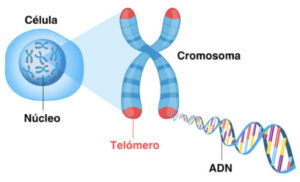
Thus, telomeres protect the genetic information in the nucleus of chromosomes and also have the important function of helping their DNA replicate more easily, allowing cell division and, therefore, the formation of a new cell. The absence of telomeres prevents the cell from duplicating, causing the parent cell to be unable to produce new daughter cells.
This is how the body ages.From all of this, it is deduced that the longer the telomeres, the better protected the cells are and the more easily they can reproduce and regenerate their organs. This sequence, as long as it remains unaltered, could give us infinite life.The problem is that with each cell division, telomeres lose dozens or hundreds of nucleic acids, since they are programmed to act only during each cell division. This means that as years pass, telomeres become progressively shorter, which in turn leads to a gradual slowing of the cell division process, entering a period called "senescence" (cellular aging).
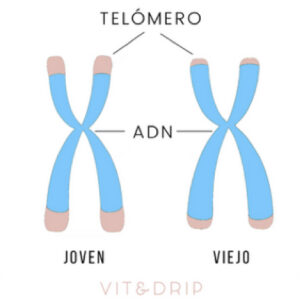
When telomeres become too short, the genetic material is left unprotected and can no longer fulfill its protective role, causing the cell to stop dividing, enter “senescence,” and eventually die without being replaced. Moreover, the lack of protection for genetic material promotes the emergence of random mutations in the chromosomes, thereby increasing the risk of cancer, cardiovascular diseases, and neurodegenerative processes. In short: our greater or lesser life expectancy is linked to the length of our telomeres.
It has been demonstrated that people with short telomeres live shorter lives and have a higher incidence of developing cancer. For example, the annual mortality rate is 5.1 cases per 1,000 among people with long telomeres, whereas the figure rises dramatically to 22.5 cases per 1,000 among those with short telomeres, representing a 4.4 times higher risk.
Based on all of this, science is seeking substances that can directly influence the preservation of telomeres. Nature, in particular, serves as the source of knowledge for researchers, with the hope of finding the long-sought “fountain of youth.” An important point to note is that the body is not always passively watching its telomeres degrade. Indeed, we now know there is an enzyme called telomerase that allows telomeres to maintain their optimal length. This enzyme was discovered by three researchers—Elisabeth Blackburn, Carol Greider, and Jack Szostak—who were awarded the Nobel Prize in Medicine in 2009. Since then, major discoveries have been made regarding telomerase function. For example, animal organisms that live over 200 years have “super-active” telomerase, so their telomeres shorten minimally over the years. Classic examples include clams (500 years), red sea urchins (up to 200 years), Aldabra giant tortoises (around 500 years), and bowhead whales (up to 200 years). In humans, telomerase is highly active from the embryonic period until the closure of the bone epiphyses (the final stage of growth). From that point onward, its protective function declines significantly.
Continued in second part.


